
An instrument on a Zynthian is a file on the disk: a CLAP or LV2 binary. What the player sees is a row in a menu with its figures, a chain with a MIDI input, controller pages with knobs, a MOD GUI, and a footer saying what the chain will cost. Five stages turn one into the other. Each stage has one owner, writes one artefact in a fixed place, and what comes after reads that artefact and nothing else.
The running example is an instrument: Kars, an LV2 plucked-string synth, in the captures from the device; Surge XT (CLAP) where its figures matter; and an effect once, to show where the layout differs.

1. Scan and describe
Owner: plugin-hostd. Writes: the descriptor, one JSON document per plugin binary under
/var/lib/omx/descriptors, named <id>@<version>-<hash>.json.
The daemon loads the plugin once in the matching host (omx-clap-host for CLAP and for the LV2 plugins its adapter takes, mod-host for the rest) and reads everything the plugin declares: id and version, audio and MIDI ports, every parameter with symbol, name, unit, range, default, steps or enumeration, flags, declared latency, and the extensions it supports.
For an instrument the descriptor says what an effect's does not: a MIDI input port, and so the notes it takes, its parameters and its presets. Kars's descriptor has the three parameters the engine later shows on its one page: Sustain, Release and Volume.
The descriptor must fit the contract: omx-contract defines the vocabulary (units, port kinds, scopes, outcome codes), and a scan that finds an unknown unit or field is refused, not invented. OpenMixer's own plugins skip the scan: their parameters are written once in a declaration, and a generator writes the descriptor, the LV2 bundle, the CLAP parameters and the parameter reference from it.
2. Qualify
Owner: plugin-qualify. Writes: the qualification record, <plugin>@<version>-<hash>.<offer>.qualification.json,
with the probe output it judged beside it, under /var/lib/omx/qualification.
The probe runs the plugin at every cell of a grid (44.1, 48, 96 and 192 kHz times blocks of 128, 256, 512 and 1024 frames) and writes the record: the checksums of the binary's files, the cost per block, declared and measured latency, real-time safety under the interposer, or a reason code for each cell that did not run. For an instrument the probe holds a set of notes while it measures, so the cost is the cost with those voices sounding.
A verdict for each host follows: suitable, isolated (it runs in a worker of its own and is never grouped), or unsuitable. Kars is rated suitable for omx-clap-host, real-time safe under a parameter sweep and under notes, hosted isolated. The Pi's figures are in plugin-hostd on a Raspberry Pi 5, and Surge XT's in Instruments on a Pi 5.
3. Pins
Owner: plugin-qualify. Writes: /var/lib/omx/qualified.pins, one line per plugin.
From the records, one line per plugin says what plugin-hostd may host and how (see Pins on first use). The daemon loads the pins as its only source of permission, and its planner reads them to group workers and to place them on cores. An instrument is never put into a chain's shared worker, so a fault or a late buffer in a voice cannot reach the effects after it.
That is also what the cores need. Surge XT 1.4.0 ignores CLAP's thread-pool extension, so one instrument is one audio thread. Several instruments use several cores when each is in its own worker and the workers are spread over the audio cores, with the daemon kept off them.
4. Layout
Owner: omx-panel. Writes: the pages, computed from the descriptor by omx-panel layout --descriptor; the record
keeps the layout scheme and hash it was judged against.
The layout turns a descriptor's parameters into pages: sections become groups, and every control gets a stable key. The same layout drives the engine's controller pages in Zynthian, the MOD GUI generated for MOD-UI, and the bundle that adds groups to third-party LV2 plugins (see Why most LV2 plugins on a Zynthian need inferred port groups).
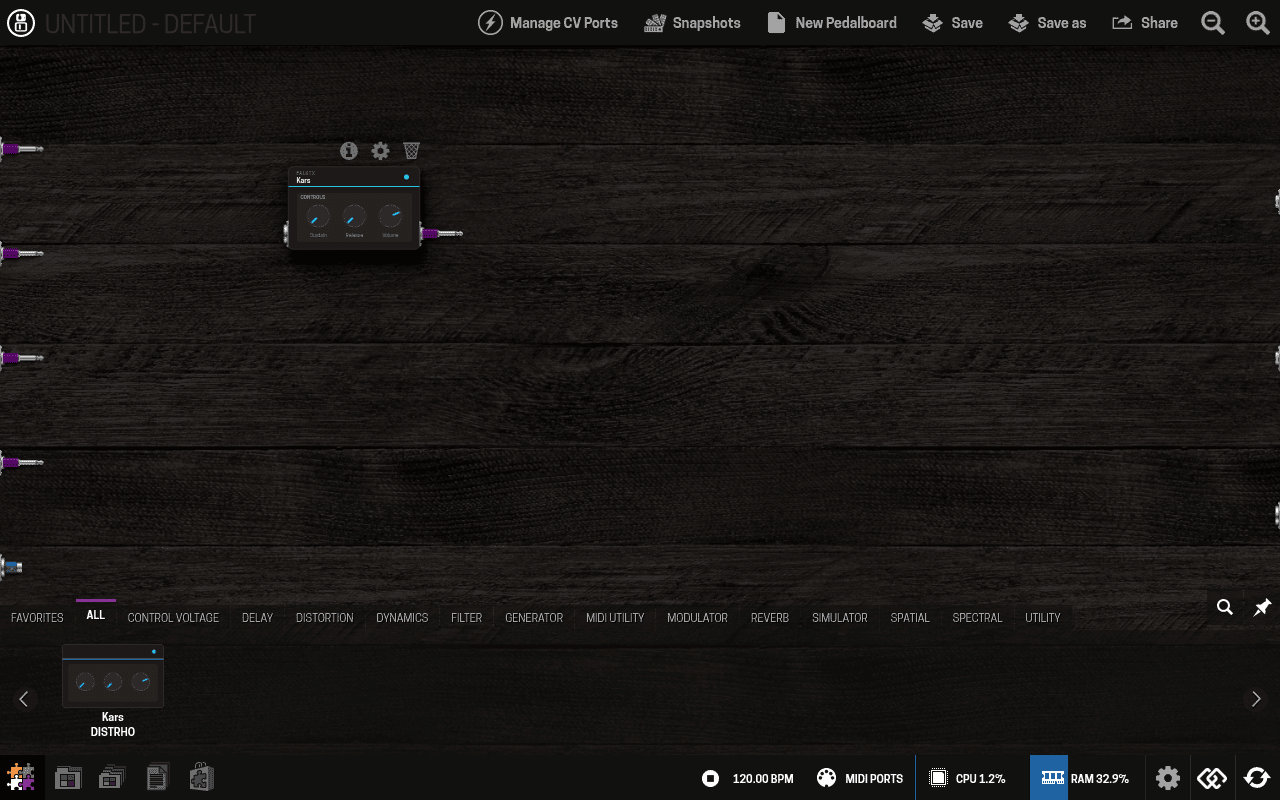
Kars has one group of three knobs, and so one page, "Controls". An effect lays out differently: OpenMixer's equaliser puts each band on a page of its own.
5. Read on the device
Owner: Zynthian's user interface, with the daemon. Writes: nothing; it reads.
The interface reads the pins for its menus, the records for latency, real-time safety and cost on each row, and the layout
for the pages. Before an insert it asks the daemon's estimate verb what the chain will cost. Nothing is computed twice:
the descriptor for parameters, the record for figures, the pin for permission, the layout for pages.
Each artefact through its owner's reader
The interface keeps no copy of what the stages wrote and no code of its own that reads their files. It reads each one through the reader its owner ships, all of them in Python:
- The daemon. Every line to plugin-hostd and every answer from it goes through plugin-hostd's client,
plugin_hostd_protocol, which encodes and parses the protocol as its installed table declares it. - The record. A menu row's qualification is plugin-db's record reader,
plugin_db.query, and the reason for a verdict isplugin_db.why. - The descriptor. The interface asks the daemon which file holds the plugin's descriptor (
descriptor_get): its scan, or a describe the interface runs when the daemon has none. omx-panel lays the pages out of that file. - A control's position. Where a knob sits for a value, drawn and nudged, is omx-contract's position law, read through
its scale reader,
omx_contract_scale. - What an answer says. An owner's code is shown in the device's language, as
LC_ALL,LC_MESSAGESorLANGnames it: plugin-hostd's client reads the sentence from the owner's installed catalog, plugin-db's reasons go through omx-contract's catalog reader, and a code with no entry shows its English source sentence.
When an owner changes its data or its reader, the interface follows without a change of its own.
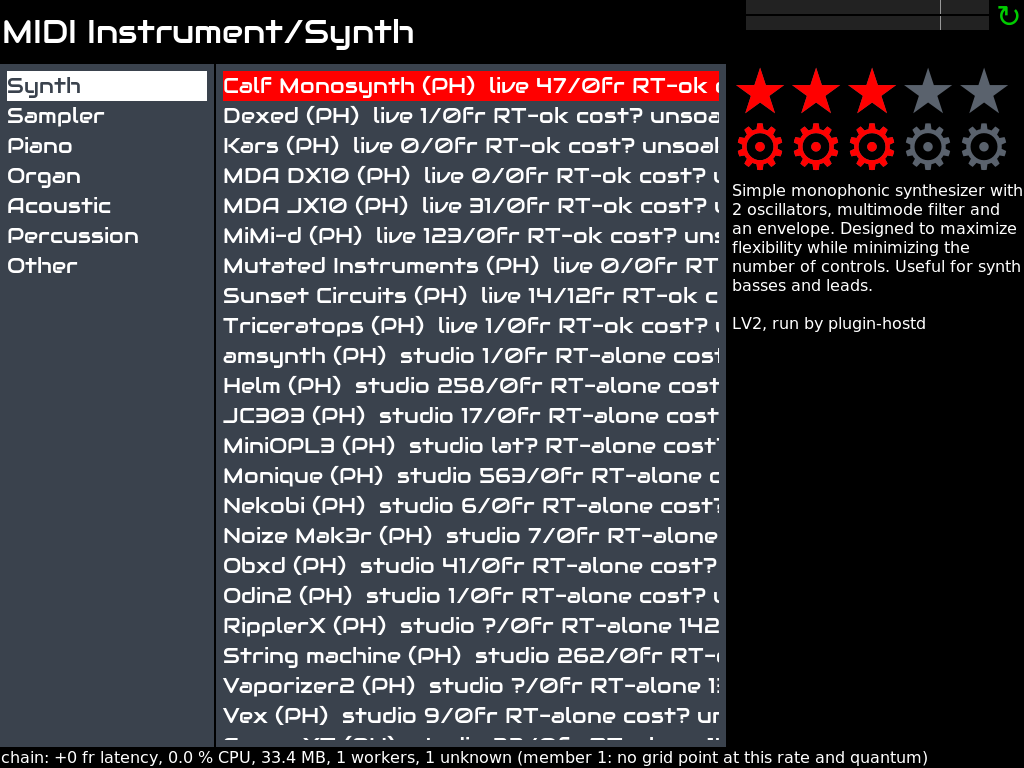
On the device, the plugin menu: each row with its tier, latency (measured and declared frames), real-time safety and cost:
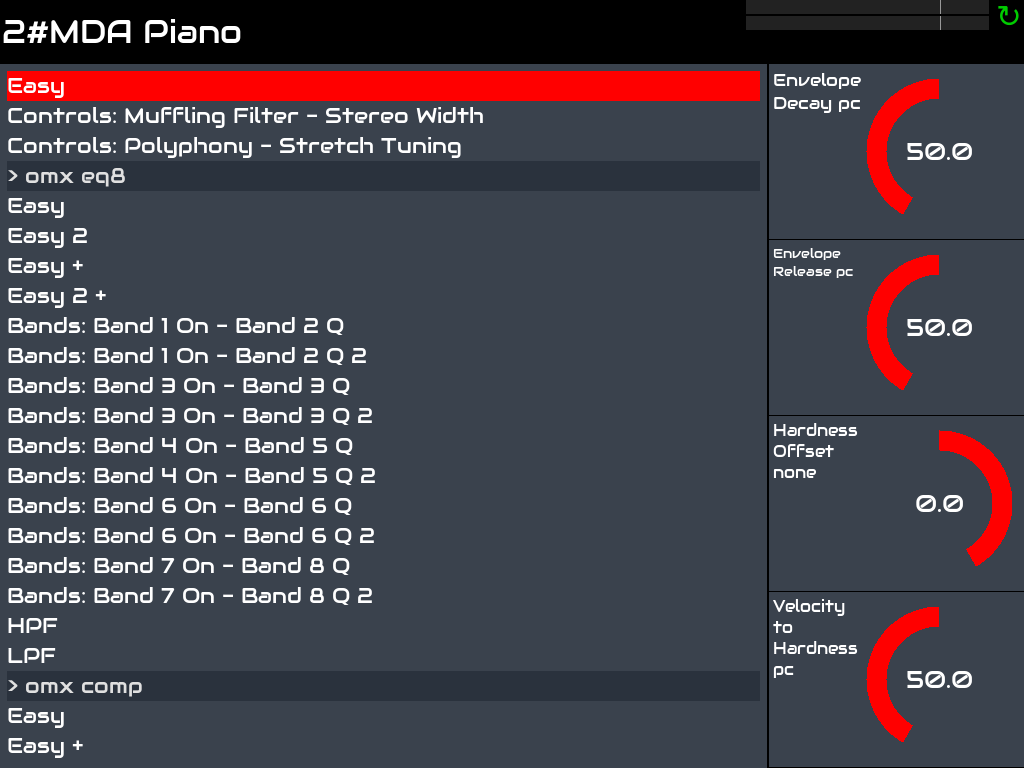
an instrument's controller page, with the sections of the omx eq8 and omx comp in its chain:
the MOD GUI of Kars, from its layout:
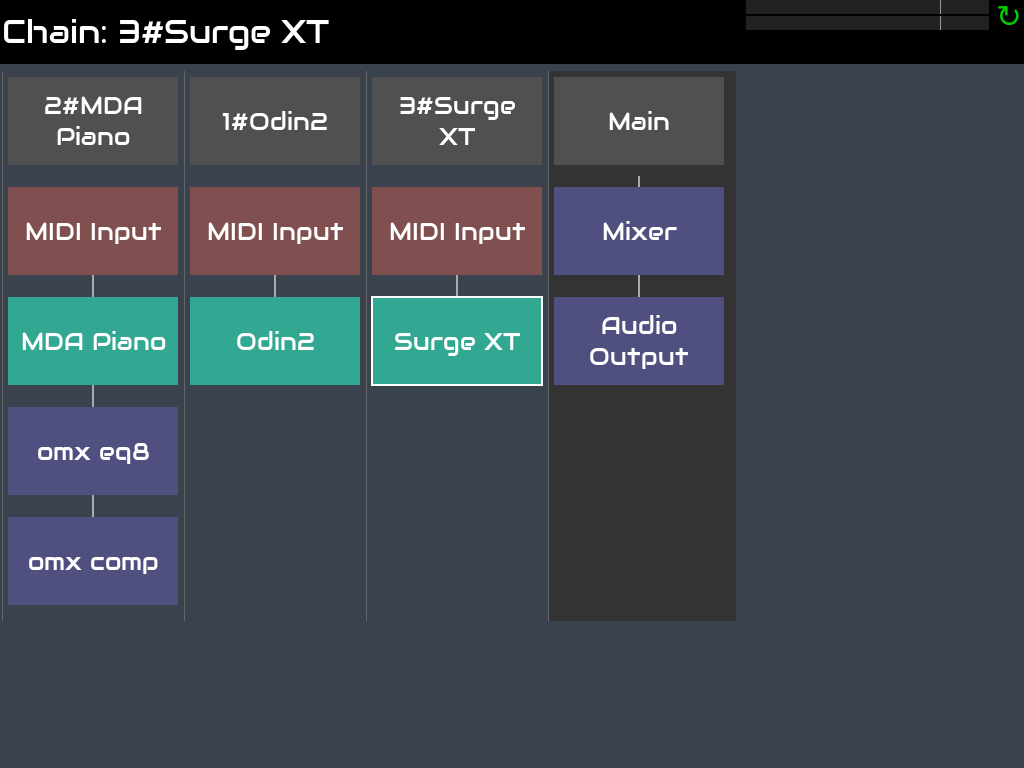
and the chains, with the instrument, the equaliser and the compressor:
A fresh device does not repeat the long stage. A package ships the records and pins of a known plugin set, keyed by checksums, so a fresh device applies them and probes only what differs.