Features

What it does, and how far it has been proven.

Three labels, and they mean different things. Proven on the rig means a person drove it on a real console with real hardware. Built and measured means audio was measured through it. In development means the code is landing and nothing has proved it yet.

The desk

Proven on the rig

Input channels with head gain, trim, pan, polarity, phantom and pad; a full processing rack per strip; buses, aux sends with pre and post tap points, DCAs, a matrix, mix-minus, stereo channel linking and output inserts.

Sessions persist and reload at boot. Scenes recall. Mute groups, solo (PFL, AFL, solo-in-place with an arming step), a dim, and two panic buttons that separate the mains from the whole console.

Mix-minus is a first-class kind with its own addresses rather than an index-offset hack. Buses and MAIN are strips like any other — there are no master-only mechanisms hiding behind a different code path.

Two honest exceptions worth knowing before you plan a show around them: the matrix has been measured digitally silent with a crosspoint open, and a show load is not a clean slate — loading show B over show A leaves A's curves, dynamics and tails running on every channel B does not mention. Both are open, and both are listed under known limitations below.
Native processing

Built and measured

A parametric EQ bank with a graphical curve, a gate, a compressor, a delay line and a reverb — all of them in the console's own C node, all of them checked against hand-computed values rather than against a recording of themselves.

Moving a fader, a mute, a pan, an EQ band, a gate, a compressor, a delay or a reverb moves audio on the kinds where the console says it does, and where it cannot, it refuses by name rather than lying. That is the strongest part of the console and it is worth saying plainly.

Real-time analyser

Proven on the rig

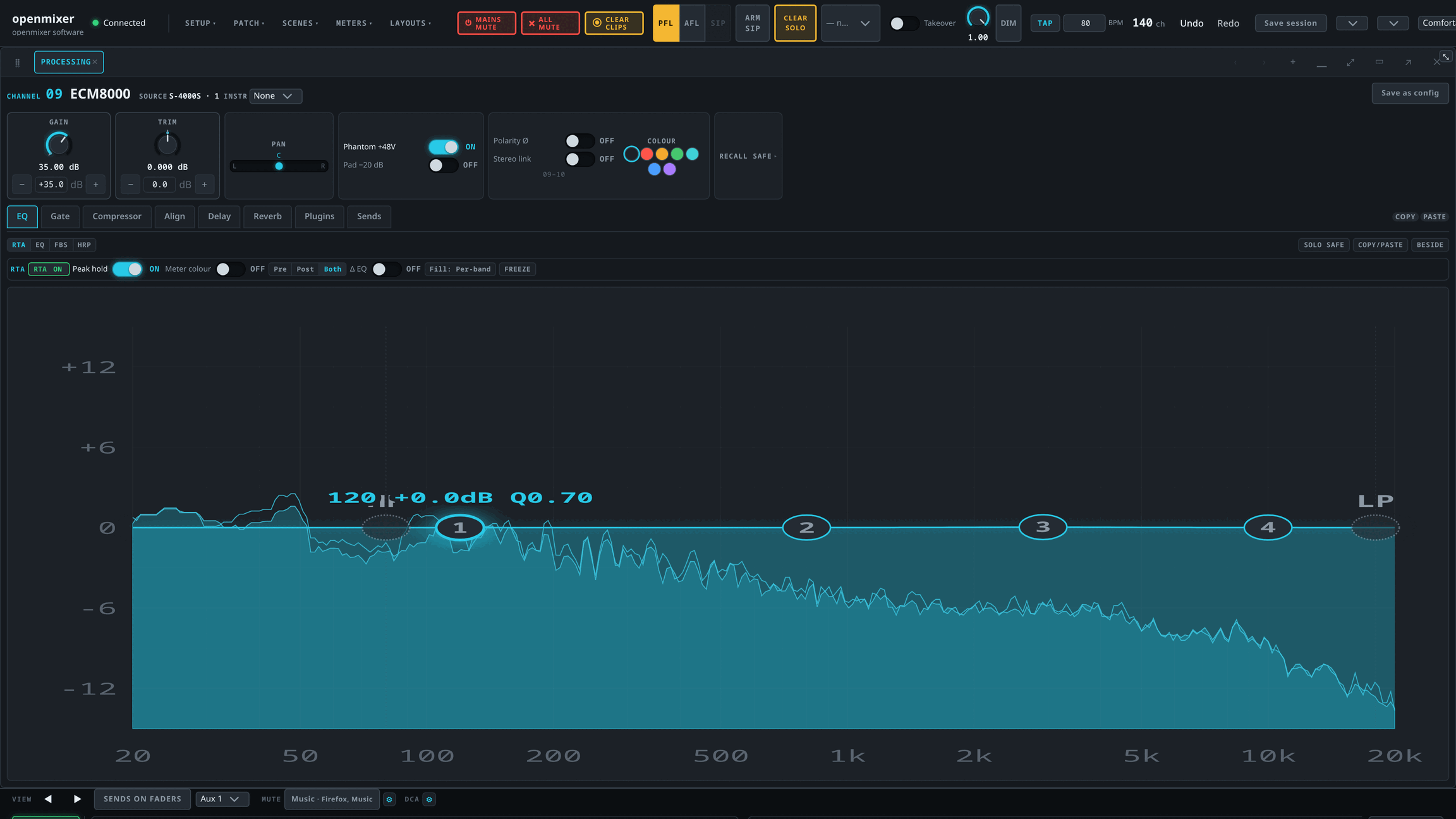
A native FFT with a multi-resolution zoom tier — bins of about 0.73 Hz below a 300 Hz crossover, where a broad-band analyser tells you nothing useful. Peak hold, pre- and post-EQ overlay, and a per-band difference trace.

Nothing computes unwatched. The analyser is demand-gated per channel and the arming survives a reload because it rides the session, not the browser. Buses got their own analyser on 2026-09-01, proven by feeding a tone into one bus and reading the spectrum peak at the fed frequency while a bus with no send read a floor with no peak.

The analyser at full height: a live spectrum from 20 Hz to 20 kHz with peak hold and four EQ band handles on the curve.
The analyser running on a live input, with the channel's EQ band handles on the same curve.

Feedback detection and correction

Proven on the rig

The detector watches for the signature of a ringing room and the corrector plants notches into the channel EQ. Two modes with genuinely different behaviour: a ring-out pass plants a true full-cut notch at a very high Q, while live mode plants a gain-carrying bell whose depth comes from the signal's peak-to-average ratio.

Live-mode notches lift again in staged ramps as the room settles — two thirds, one third, gone — and re-clamp with a doubled hold if the frequency comes back. It never touches an operator's own bands; only its own tagged ones.

It is declared input-only by design. Feedback correction on aux, mix and matrix strips is not offered yet.

Smart alignment

Proven on the rig

Two microphones on one source arrive at different times. Pick the reference, watch coherence rise, apply. The fit reads the phase slope across frequency, which is why it needs programme material — a pure tone cannot measure delay, because a sine occupies one bin.

It corrects with delay and polarity, and reports the residual rather than silently correcting it. A control that says "137°" without naming the frequency invites the operator to discover that changing the analysis band changes the answer.

Known limitation: a saved show does not carry the alignment, and loading one clears it. Do not rely on a show file to restore it.

Measured on the rig, 2026-08-31

Dialled inMeasuredCoherence
0 ms0.000 ms1.000
0.5 ms0.473 ms1.000
2 ms1.903 ms0.998
5 ms4.731 ms0.990
10 ms9.374 ms0.767

Repeated apply converges: 4.748 → 0.252 → 0.016 → 0.001 → 0.000 ms, at a coherence of 1.000.

LV2 plugin inserts

Built and measured

Per-strip and per-output insert chains hosted by mod-host, with a plugin picker and an editor generated from the plugin's own ports.

The catalog tiers a plugin by measured round-trip latency — live at 5 ms or under, studio above it, ambiguous ones quarantined — and then ranks within a tier by curation and CPU cost, so the live-safe choice wins by default.

Insert audio is verified by measurement rather than by inspection: a tone through a real graph, a notch racked as an LV2, and a reading at the other end. The reference measurement is a baseline of −12.04 dBFS, the same notch through the plugin door at −100.56 dBFS, and bypass returning to −12.04 exactly — 88.52 dB of cut, through the plugin and not around it.

Known limitations: plugin delay compensation is computed and reported but not yet applied, so a chain with differing insert latencies is not time-aligned for you; and removing a plugin from a running chain is unreliable on some mod-host builds.

REAC stageboxes

Proven on the rig

Roland S-series stageboxes are discovered, patched and driven — including head-amp control, which is what makes them a stagebox rather than a stream. Two boxes have been established at once on the rig with all 128 links intact across a rebind, and a live 48 to 96 kHz re-pace has been run with the house up.

Phantom power has been confirmed physically at the XLR pins on two inputs with the console independently agreeing. Three sources, one answer — which is the only kind of confirmation a phantom claim is allowed to have.

The transport lives in the sibling FreeREAC projects, not in this project. OpenMixer holds the control path: discovery, head-amp, the patch and the adapter side.

Open and dated: on the S-1608 the audio patch and the head-amp addressing use two different offsets in one box; the reported set of known head-amp capabilities over-reports, so it is not proof a head-amp landed; the upper bank of a 16-input box can stay at the converter floor when it is not enrolled; and 44.1 kHz pacing has never been proven, because that needs a real desk running at 44.1.

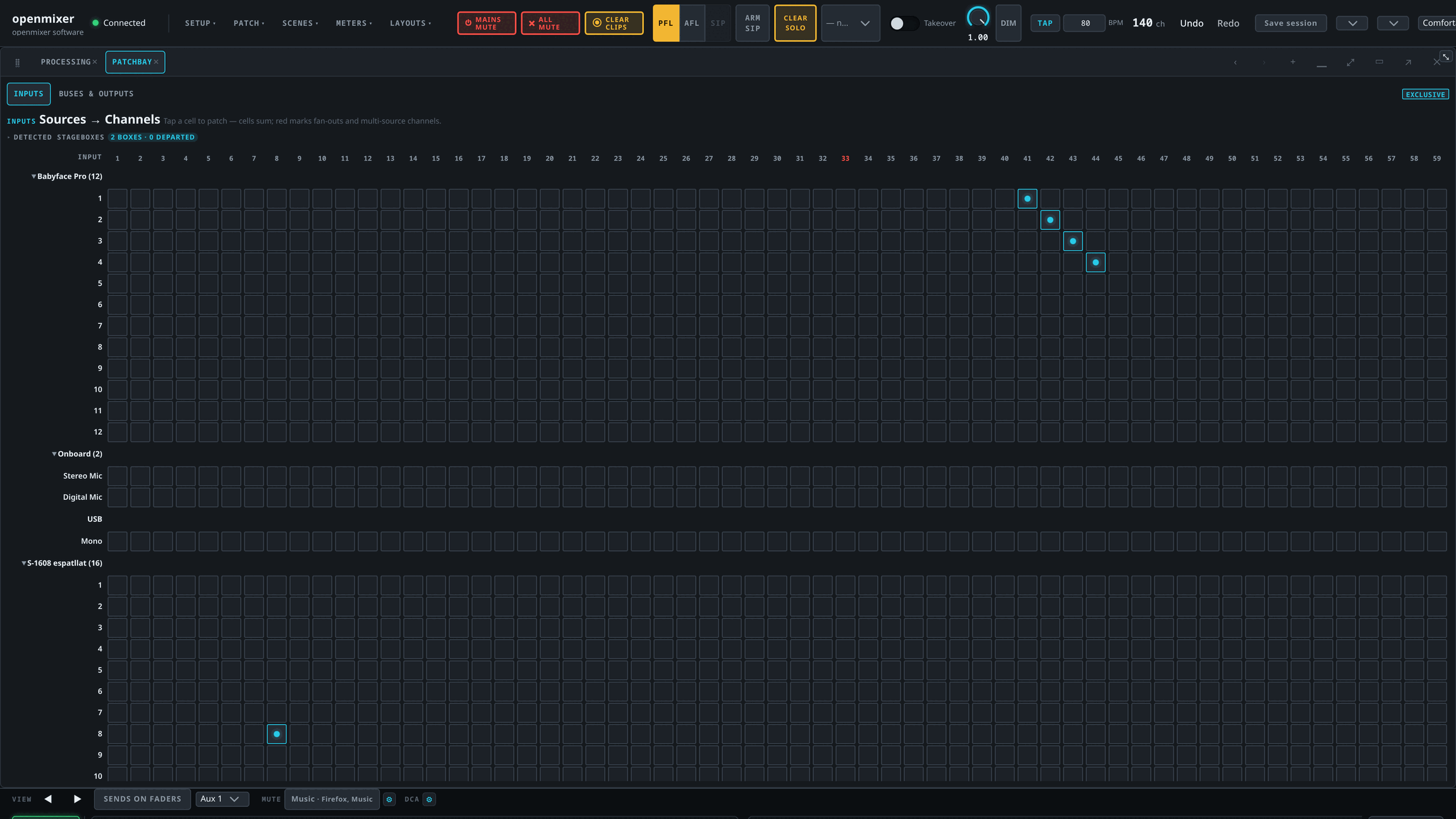
The patchbay: a crosspoint grid of sources against channels, with detected stageboxes grouped down the left edge.
The patchbay. Sources down the side, channels across the top, detected stageboxes grouped and counted.

The web surface

Proven on the rig

A fader wall with banks and user pages, channel strips with a reorderable processing rack, bus-send and matrix views, the patchbay, a graph view, a telemetry view, and a docked multi-window workspace that can be pulled apart and saved as a layout.

The banks roll under the mouse wheel, anywhere over the rail that is not itself a control: one notch is one bank, the same wrapping step the ◀ ▶ buttons make, and a trackpad swipe moves one bank rather than a dozen. A wheel over a fader still trims that fader.

English, Catalan and Spanish. Dark, light and a high-contrast theme, on an axis independent of the console personality.

Its entire state intake is one EventSource and nothing else. The surface cannot open a second channel to the console, by construction rather than by convention.

A change is a PATCH, never a reconnect. There is a deploy gate that drives a real browser through real gestures against a real console and measures long tasks, request bursts, stream re-dials, framework warnings and server-side heals — a green unit suite cannot see a frozen tab.

Control surfaces

In development

The Behringer X-Touch and X-Touch Mini are implemented as a bidirectional client: surface gestures become canonical operations, and canonical state drives the motor faders, the LEDs, the V-Pot rings, the scribble strips and the meters. It is wired into the production composition root.

It is not marked proven because none of it has been driven on a real surface: not a replug, not select, not a fader sweep, not the encoders, not the meter ladders. The code is built; the hardware verification is owed. Adapters for Midas, X32/M32 and Roland stand on the same footing — real implementations, no hardware proof.

Recorder and virtual soundcard

In development

Multitrack capture to RF64 takes at 48 kHz, a take library, and a virtual soundcard so another application on the same machine can be a source or a destination on the desk.

The design was ruled on 2026-09-01 and the code is landing now: the C capture and playback paths, the RF64 writer and its oracle tests, and the server rows are in. The arm set is derived rather than stored, and playback is refused outright when the graph rate does not match the take's, because there is no resampler on that path.

There is no rig proof yet. Treat it as unfinished.

Before you plan a show

Known limitations.

A product page that lists only what works is not a description of a console. These are the limits worth knowing before OpenMixer carries anything you cannot afford to lose, and they are the same list the manual carries.

  • Loading a show is not a reset. Loading a second show over a first leaves the first show’s curves, dynamics, delay tails and feedback notches running on every channel the second does not mention.
  • Alignment does not survive a show load. Delay alignment is not stored in the show file, and loading one clears it.
  • The matrix does not carry audio yet. The addresses, the surface and the crosspoints are there; the audio is not. Do not test it by ear and conclude something else is broken.
  • Control surfaces are unverified on hardware. The X-Touch implementation is complete and wired in, and no part of it has been walked on a real surface.
  • 44.1 kHz is unproven with stageboxes. 48 and 96 kHz have been run on the rig, including a live change between them. 44.1 has not.
  • Recording is not finished. The capture path, the file writer and the take library are landing now and nothing has recorded a show through them.
  • The console is not packaged yet.The plugin hosts are: install them from our packages.

This list changes as work lands. The documentation set carries the current version of it.

openmixer

A software mixing console for Linux. The desk is the software; the browser is the surface.

Pages

Licence

OpenMixer is free software under the GPL-3.0-or-later. Every package in the workspace carries the same licence.

Roland, Midas, Behringer, RME and the product names used here belong to their respective owners. OpenMixer is an independent project and is not affiliated with any of them.